



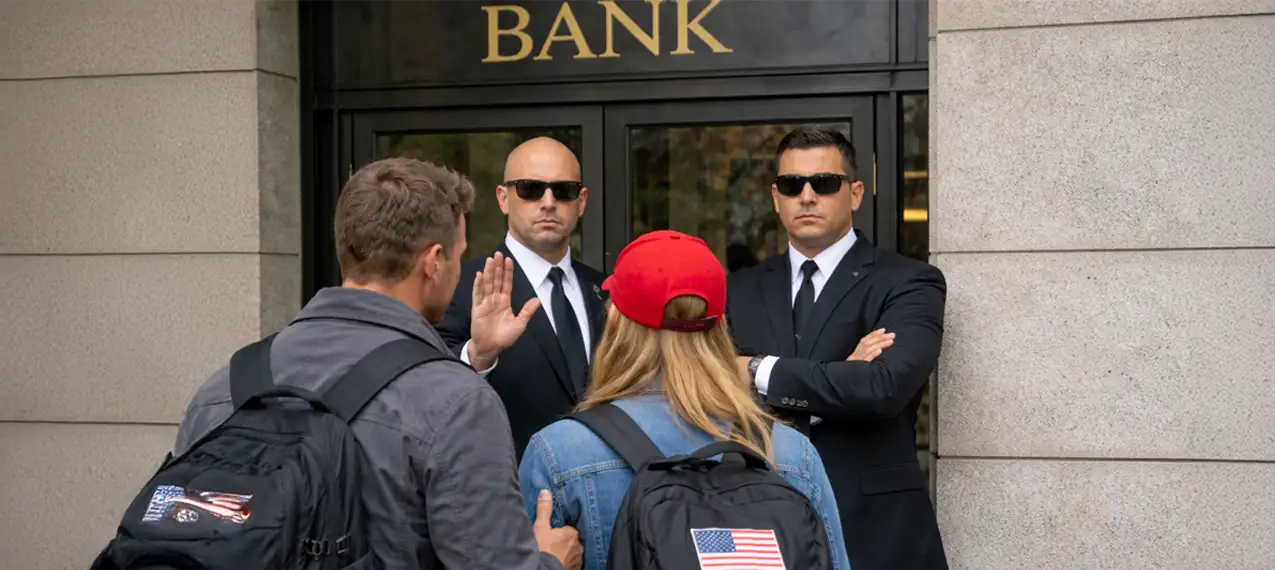
In late December, Landmark Legal Foundation filed two comments in support of two proposed federal rules that aim to prohibit unlawful debanking based on an induvial or business’s political, religious, or social views. Promulgated by the National Credit Union Administration (NCUA), the Office of the Comptroller of the Currency (OCC), and the Federal Deposit Insurance Corporation (FDIC), the proposed rules titled “Prohibition on Use of Reputation Risk by Regulators” and “Prohibition on Use of Reputation Risk by NCUA” represent a coordinated effort to reform federal banking supervision. The rules would prohibit these agencies from “requiring, instructing, or encouraging an institution to close an account…on the basis of a person or entity’s political, social, cultural, or religious views or beliefs”1 by eliminating subjective—and often abused—reputational risk factors from regulatory decision-making.
Following President Trump’s August 7 Executive Order 14331 (E.O.) titled, “Guaranteeing Fair Banking for All Americans,”2 these agency actions move the banking industry in the right direction. Under the Biden Administration, regulators relied on subjective reputational risk assessments, along with other tools, to restrict law-abiding American families and business owners from accessing financial services based on political or religious beliefs, or otherwise lawful business activities.
OCC findings demonstrate how reputational risk factors led private financial institutions to restrict financial services for law-abiding Americans and lawful industries. Between 2020 and 2023, OCC observed an adoption of policies that required heightened scrutiny of entire economic sectors based on perceived public perception or alignment with institution’s values.3 Commonly targeted sectors included energy production, firearms, and tobacco, as well as the Christian organization Indigenous Advance Ministries, which was allegedly debanked because of its pro-life views.4
Similarly, a December 2025 report published by the House Committee on Financial Services documented the Biden Administration’s coordinated attempts to debank digital assets holders. The report revealed that in 2023, banking regulators signaled a preemptive shift toward heightened scrutiny of the digital asset banking sector. Based on subjective standards and repeated public warnings, the government encouraged widespread risk aversion, leaving banks uncertain and the broader asset ecosystem effectively frozen out. 5 In total, the Committee documented at least thirty digital asset entities and individuals who lost banking access between 2022 and 2024.6
These Proposed Rules better align these agencies’ regulatory schemes with their respective enabling statutes. Reputational risk is never mentioned in statute; it is instead a product of the expansion of the administrative state. In the late 1980s and 1990s, the OCC and FDIC adopted risk-based supervisory approaches, followed by NCUA in 2002.7 NCUA’s definition of “reputation risk” emerged via guidance documents rather than formal rulemaking.8 This administrative end-run underscores why financial regulators must formally codify the elimination of reputational risk as a basis for unlawful debanking.
These Proposed Rules represent a clear improvement over existing policy, but the Administration could go further to protect the banking rights of law-abiding Americans and lawful industries. As currently drafted, the rules still leave open the possibility that agencies could pressure institutions to terminate banking relationships based on perceived reputational concerns.9 The Administration should therefore seek to comprehensively prohibit any use of reputational risk tied to political, cultural, or religious circumstances.
Once the agencies review submitted comments and make any necessary amendments, a final rule will be published with an effective date of at least thirty days after publication. While it has been encouraging to see agencies already move away from reputation risk in practice, codifying these Proposed Rules is essential. Banking regulation should be grounded in objective financial factors, not political affiliations, religious beliefs, or lawful industry participation. Doing so will ensure that oversight targets genuine threats to the U.S. financial system—rather than serving as a tool for advancing an ideological agenda.
Read the comments here and here.
Footnotes
- Id. ↩︎
- Guaranteeing Fair Banking for All Americans, 90 Fed. Reg. 38925 (Aug. 7, 2025). ↩︎
- Off. of the Comptroller of the Currency, Preliminary Findings from the OCC’s Review of Large Banks’ Debanking Activities (Dec. 2025). ↩︎
- Jordan Sattler, The Rise of Debanking, ADF Church & Ministry Alliance (Aug. 30, 2023), https://www.adfchurchalliance.org/post/the-rise-of-religious-debanking. ↩︎
- Staff of H. Comm. on Fin. Serv., 119th Cong., Operation Choke Point 2.0: Biden’s Debanking of Digital Assets (Dec. 2025). ↩︎
- Id. ↩︎
- Julie Andersen Hill, Regulating Bank Reputational Risk, 54 Ga. L. Rev. 523 (2020). ↩︎
- Id. at 546. ↩︎
- 12 C.F.R. § 791(C). ↩︎
RECENT POSTS
 EPA’s Final Rule Revoking the Endangerment Finding: A Major Step Toward Regulatory Reform
 Landmark Files Amicus Brief in Relentless v. Department of Commerce
 SCOTUS May Keep Lisa Cook at the Fed, Preserving Independence
 Victory! Supreme Court Expands Candidate Standing In Election Law Challenges!
 Landmark Submits Comments Supporting Anti-Debanking Regulations
SUPPORT LANDMARK LEGAL FOUNDATION
We are truly facing existential threats to our individual rights and liberties, the Constitution, and our national character. If unchallenged, this assault on our very way of life will ruin our great nation. With your financial and moral support, Landmark is not going to let that happen without a fight. Will you join us?
JOIN OUR MAILING LIST
Never miss an update from Landmark Legal Foundation as we continue the fight to preserve America’s principles and defend the Constitution from the radical left.